Dental treatment in Düsseldorf
Root canal treatment
When tooth decay has advanced so far into the teeth that the nerve and pulp have been affected, the dentist has to carry out what is known as endodontics, that is, a root canal treatment.
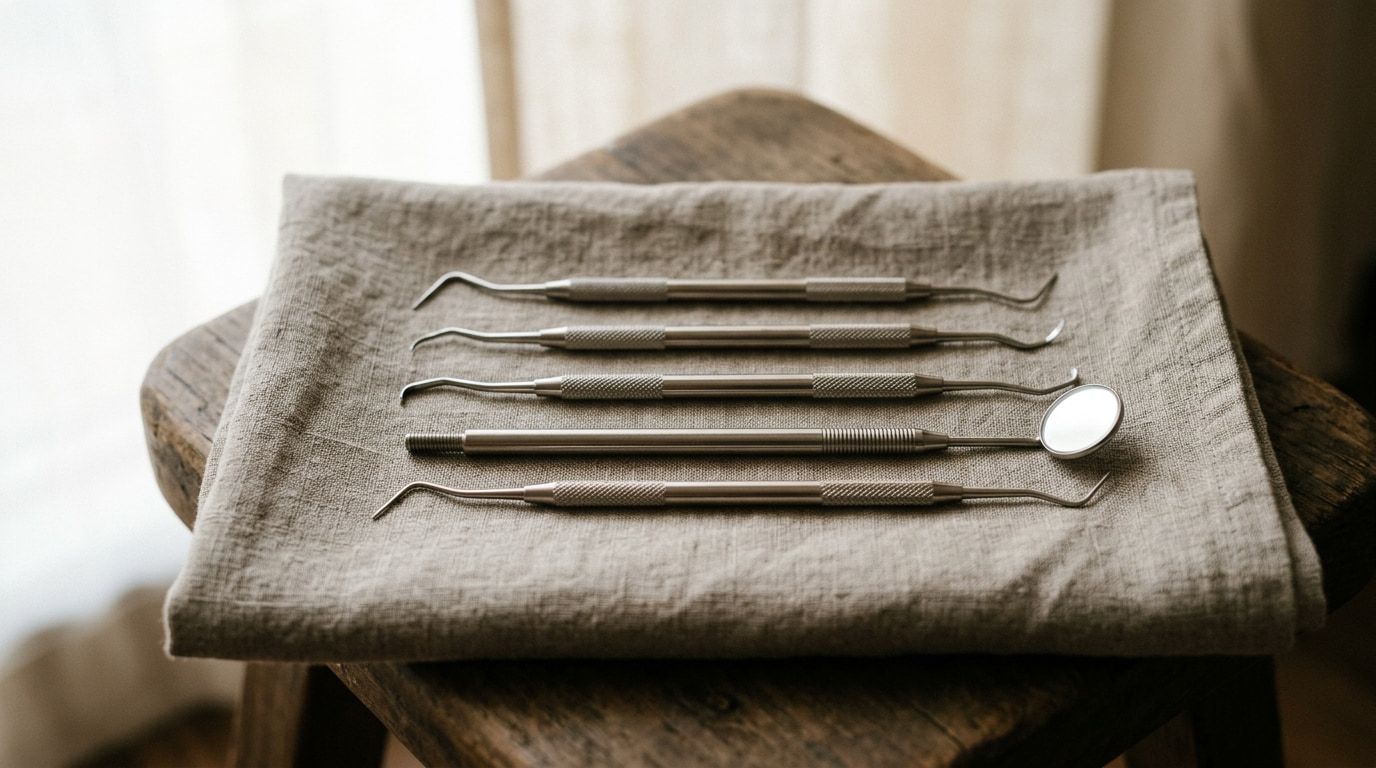
Endodontics: root canal treatment with success
The dentist removes the infected nerve tissue in the root canals, widens and disinfects the canals by placing medication, and seals them bacteria-tight with a root filling.
This procedure, simple to describe, can be carried out without problems on some teeth with straight, wide and round canals. But even the treatment of the lower incisors, the first premolars or the rear molars, with their great variety in the shape and number of root canals, presents the practitioner with major problems.
The success of treatment becomes limited and uncertain. The result is pain. In the worst case, the tooth may be lost.
Our approach
Endodontics
Preparing these varied root shapes, with up to five canals and sometimes sharply curved branches, therefore requires special training and care from the dentist so that patients can be treated without pain.
Specialists in the field of endodontics, such as the American Prof. F. Wine and the Norwegian Prof. L. Tronstadt, have gathered the fundamental knowledge in decades of research and developed special techniques for pain-free preparation, disinfection and filling of the root canals. At the cost of considerably more time, these techniques lead to pain-free treatment with predictable and lasting success.
We will be happy to give you further information on endodontics according to Wine in a personal consultation.
Techniques of endodontics
-
Rubber dam
A special feature of this technique is a rubber membrane, the so-called rubber dam, under whose protection the canals are treated in a germ-free way. The risk of germs being carried over from the oral cavity, with inflammation and pain, falls to almost zero. In addition, a special range of particularly fine instruments and filling materials is needed to treat all canal shapes optimally. The sterilisation of these instruments, which is even carried out during treatment, is of particular importance.
-
Surgical microscope
Specialists who work specifically in the field of endodontics, such as Dr. Kascha MSc, who works in our practice, use a surgical microscope with 64x magnification to enter the finely branched world of the root canal system. There they track down small lateral canals, clean and disinfect them, and finally seal them bacteria-tight with a synthetic resin (root filling).
-
Saving the tooth
In this way the tooth can be saved in 90% of cases, even when it shows clear signs of inflammation at the root. "Problem teeth" that did not become pain-free after a previous conventional root canal treatment can also be saved by an endodontic revision.
Appointment
Questions about Root canal treatment? Talk to us.
We will be happy to answer all your questions in a personal consultation.